
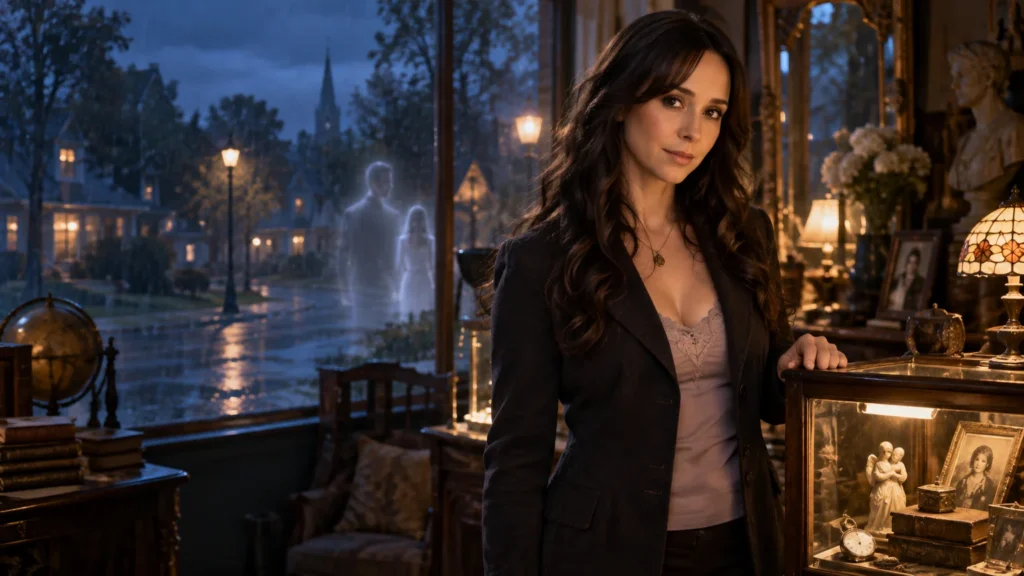
TLDR: The clearest explanation for why ghost whisperer was popular is that it offered supernatural suspense without making fear its only attraction. Most episodes turned a haunting into a story about grief, forgiveness, reconciliation, or one last goodbye. Jennifer Love Hewitt made that formula work by playing Melinda Gordon as compassionate and emotionally open rather than detached or cynical. A repeatable case-of-the-week structure made the series easy to enter, while its Friday-night CBS audience demonstrated substantial broadcast reach.
That combination also explains why Ghost Whisperer became one of Hewitt’s defining roles. The series gave her a character who could be frightened, funny, romantic, and openly moved by another person’s pain in the same episode. Its popularity should not be confused with universal critical approval: contemporary responses were mixed, particularly over the show’s earnest sentimentality. Yet the qualities that some reviewers found excessive were closely connected to what made the program distinctive and comforting.
Why Ghost Whisperer was popular: the paranormal became personal
CBS introduced Ghost Whisperer as the story of newlywed Melinda Gordon, a woman able to communicate with earthbound spirits whose unfinished business prevented them from moving on. The network’s description allowed for stories that could be chilling, heart-rending, or humorous, establishing a wider emotional range than a straightforward weekly horror series. The show premiered on September 23, 2005.
The premise created two questions for almost every episode. The first was supernatural: Who is the ghost, and why is this spirit appearing now? The second was emotional: What truth must be discovered or communicated before the dead and the living can let go? The mystery supplied momentum, but the answer usually mattered because it changed a relationship.
That distinction is central to the show’s appeal. A ghost might initially appear threatening, confused, or visually frightening, but the haunting was often a symptom of unresolved human pain. Melinda’s task was not simply to defeat a supernatural opponent. She had to listen, investigate, interpret fragmented messages, and help people confront something they had avoided.
The resulting stories could accommodate loss without ending in complete despair. Death remained painful, but communication made understanding possible. In a television landscape filled with crime investigations and darker supernatural conflicts, Ghost Whisperer repeatedly led its audience toward emotional release.
Closure was the real weekly payoff
The show’s basic pattern was dependable without requiring every story to feel identical. An apparition disrupted Melinda’s daily life. Its motives were initially unclear. Investigation revealed a concealed history, misunderstanding, betrayal, or unspoken message. Melinda then brought the spirit and a living person close enough for a final exchange before helping the ghost move on.
That structure offered several kinds of satisfaction at once. Viewers received the tension of a haunting, the clues of a mystery, and the emotional resolution of a relationship drama. The supernatural device also made interior feelings visible: guilt could pursue someone through a dark room, anger could disturb a seemingly peaceful home, and love could persist as an urgent message that had not yet reached its intended recipient.
Crucially, the resolution was not always a tidy declaration that everything had been fixed. Some losses could not be reversed, and some revelations arrived too late to repair a life. The recurring promise was narrower but still powerful: the truth could be heard, a burden could be shared, and a goodbye could become possible.
This made the series relatively easy to sample. A viewer could understand the central problem of an individual episode without mastering a complicated mythology first. Longer-running relationships and supernatural developments rewarded regular viewing, but the weekly guest story provided its own beginning, investigation, and conclusion. For a network drama scheduled at the end of the working week, that accessibility was a practical strength.
Melinda Gordon made sincerity feel natural
A procedural format only works when viewers want to spend time with the person guiding them through it. Melinda was unusual because her strength was expressed primarily through empathy. She entered frightening situations, but her defining ability was listening to people whom no one else could hear.
The role suited Jennifer Love Hewitt’s accessible screen presence. She did not play Melinda as a remote supernatural authority who had every answer. The character could be startled, exhausted, frustrated, and deeply affected by the grief passing through her life. That vulnerability helped preserve a sense of danger while keeping Melinda emotionally available to both the ghosts and the audience.
A contemporary Los Angeles Times review was mixed on the series as a whole, yet it identified moments in which Hewitt effectively conveyed emotional fatigue and happiness, including a reunion involving a dead veteran and his adult son. That observation points to an important part of the performance: Melinda’s reactions frequently provided the bridge between an extraordinary premise and an ordinary human need to be understood.
Hewitt also had to commit to material that could have collapsed under visible irony. Ghost Whisperer presented tearful reunions, spiritual release, and messages from the dead with very little emotional distance. Her performance invited viewers to accept that sincerity as the show’s operating language. Whether a particular viewer found it affecting or overly sentimental depended on taste, but hesitation from the lead would have weakened the entire format.
The role consequently gathered several familiar sides of Hewitt’s screen identity into one character. Melinda could carry the vulnerability associated with romantic drama, the alertness required by a thriller, and the warmth needed for domestic scenes. Readers revisiting the series itself can also explore the broader supernatural journey of Ghost Whisperer.
It was comforting television with room for scares
Ghost Whisperer occupied a useful tonal middle ground. Its spirits allowed for shadowy figures, sudden appearances, ominous warnings, and occasional menace. Its destination, however, was more often compassion than conquest. The question was not only how to stop the ghost; it was why the ghost could not leave.
That made the series approachable for viewers who enjoyed paranormal stories but did not necessarily want relentless horror. It could create unease before returning to the warmer visual and emotional world surrounding Melinda. Her marriage, home, work, and community gave the program a stable center from which each haunting could depart and to which it could return.
This rhythm made sadness manageable, too. Episodes could address sudden death, fractured families, regret, and loneliness, but the recurring act of crossing over placed a boundary around the pain. The series did not claim that grief disappears. Its dramatic ritual suggested that recognizing grief and speaking the missing words might allow life to continue.
Friday-night reach mattered
The series did not merely develop a reputation after its original run; it reached a substantial audience when it debuted. CBS reported 11.25 million viewers in its premiere-week measurement. Contemporary trade coverage from TVWeek’s report on the Friday audience described Ghost Whisperer as the most-watched program on the first Friday of the 2005–06 television season.
One premiere figure cannot reveal exactly why each viewer tuned in, and ratings should not be treated as a direct measurement of affection. They do establish that the show’s premise and star attracted broad attention in its original broadcast setting. The scheduling context matters because Friday can reward programs that are easy to understand, tonally dependable, and suitable for viewers seeking a complete story rather than a demanding serialized commitment.
CBS later credited Ghost Whisperer and Close to Home, alongside Numb3rs, with helping the network lead Friday viewing among total viewers and selected demographic measures during the 2005–06 season. That was the network’s own assessment of its schedule, but it supports the narrower conclusion that Ghost Whisperer functioned as part of a successful Friday lineup.
The pairing of a recognizable star with a clear weekly promise was especially well suited to broadcast television of the period. Promotional material could summarize an episode through one haunting and one emotional question. Viewers who missed a week could return without being completely lost. Regulars still had continuing reasons to care about Melinda’s relationships and the changing rules around her ability.
Popularity did not mean universal critical acclaim
A complete retrospective has to preserve the disagreement surrounding the show. Contemporary Washington Post coverage characterized Ghost Whisperer as an earnest drama built around spiritual resolution, while other criticism objected to its heavy sentimentality. The Los Angeles Times review likewise found significant weaknesses even while recognizing effective moments in Hewitt’s performance.
Those responses are not incompatible with the program finding an audience. Television can connect because its emotional intentions are obvious, not despite that fact. Ghost Whisperer rarely hid what it wanted a climactic reunion or farewell to mean. Viewers who accepted its tone knew that the suspense was likely to end with catharsis; viewers resistant to that tone could find the same sequence manipulative or excessive.
It is therefore more accurate to call the series popular and durable than universally beloved or critically acclaimed. CBS News reported its cancellation on May 18, 2010, with the final episode airing on May 21. Its run gave Hewitt years to develop Melinda beyond the initial premise and left the character closely associated with her career.
Why Melinda remains a defining Jennifer Love Hewitt role
Melinda Gordon endured as a signature role because she was not incidental to the show’s machinery. Her compassion was the machinery. The mysteries advanced when she listened carefully, the climaxes worked when she communicated another person’s pain, and the goodbyes carried weight when she visibly understood what they cost.
The part also placed Hewitt at the center of several genres at once without abandoning the qualities audiences already associated with her. Ghost Whisperer could be a domestic drama, a paranormal mystery, a romantic story, or a gentle horror program, sometimes within a single hour. Hewitt supplied the continuity between those modes.
For anyone revisiting the series, the most revealing next step is to watch an early case-of-the-week episode and pay attention to when the story changes direction. The decisive moment is rarely the first sight of the ghost. It is the point at which Melinda discovers what the haunting means to someone still alive. That turn—from fear toward empathy—is the simplest and strongest explanation of why Ghost Whisperer connected with so many viewers.
References
- Paramount Press Express | GHOST WHISPERER
- The dead have it tough too – Los Angeles Times
- ‘Ghost Whisperer’ Scares Up Friday Audience | TVWeek
- Paramount Press Express | <p>CBS BEGINS THE 2005-2006 SEASON THE WAY IT ENDED LAST YEAR: IN FIRST </p>
- Paramount Press Express | CBS WINS THE 2005-2006 SEASON IN VIEWERS AND ADULTS 25-54
- 'Ghost Whisperer': A Sixth Sense for What Viewers Like – The Washington Post
- CBS Cuts "Ghost Whisperer" and 6 Other Series – CBS News