
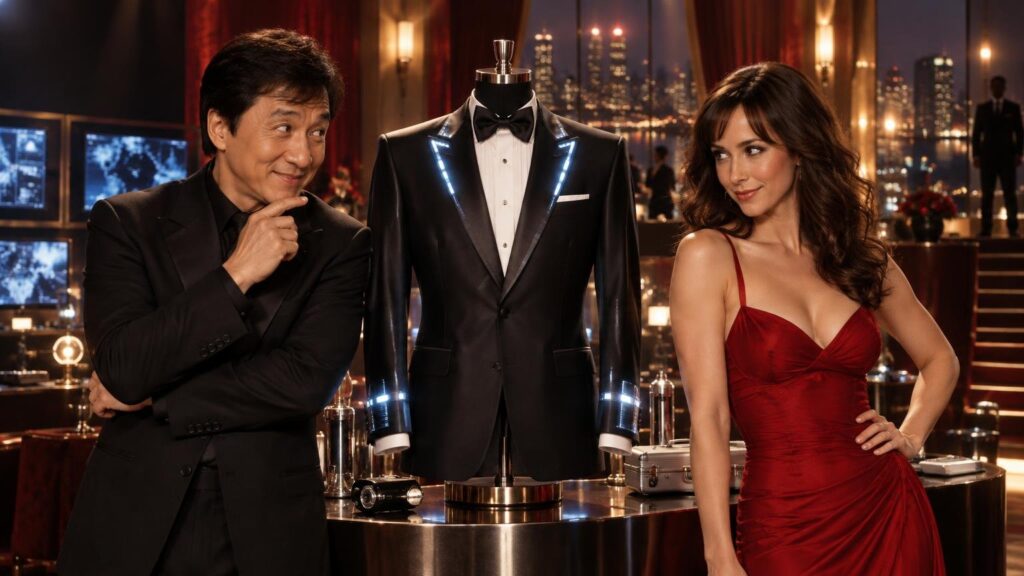
The Tuxedo is not the sharpest Jackie Chan comedy or the most substantial Jennifer Love Hewitt vehicle. It is, however, an unusually pure sample of early-2000s studio filmmaking: an expensive high-concept premise, conspicuous digital effects, a world-threatening villain, broad romantic friction and two stars whose contrasting personalities are expected to hold the whole contraption together.
Released in 2002, the movie turns Chan into a reluctant superspy by giving his character a technologically enhanced dinner jacket. Hewitt plays the rookie agent trying to complete a mission beside him without understanding who he really is. The result was poorly received by most critics, yet it remains more interesting than its reputation suggests—not because it is a forgotten masterpiece, but because its strengths and failures reveal exactly what Hollywood thought a mainstream action-comedy should be at the dawn of the new millennium.
TL;DR
The Tuxedo works best as a star-driven 2002 time capsule. Jackie Chan remains charming, and Jennifer Love Hewitt brings energy and comic impatience to a thinly written partner role. The gadget suit produces an agreeably ridiculous hook, but it also replaces too much of Chan’s physical ingenuity with effects. Revisit it for the Chan-Hewitt chemistry, the glossy studio excess and Hewitt’s playful step into action—not for first-rate espionage or peak Jackie Chan stunt work.
A superspy comedy built around one wearable gimmick
Directed by Kevin Donovan, The Tuxedo is a 99-minute PG-13 action-comedy starring Chan as New York cab driver Jimmy Tong and Hewitt as inexperienced CSA agent Del Blaine. Jimmy becomes chauffeur to secret agent Clark Devlin, played by Jason Isaacs, and discovers Devlin’s gadget-equipped tuxedo after the agent is injured. Wearing it grants Jimmy abilities that include fighting, dancing and singing. Del, meanwhile, believes she is working with Devlin rather than his alarmed chauffeur. Paramount’s official film page supplies the central premise and credits.
It is an irresistible elevator pitch. Instead of asking an ordinary man to learn spycraft, the movie lets the clothing do the work. The joke is that Jimmy can appear superhuman while remaining bewildered by the machinery controlling his body. That premise gives Chan room for nervous reactions, elastic movement and physical punch lines, even when the film’s effects are doing more of the heavy lifting than his admirers might prefer.
The threat is appropriately outsized. Del is a water expert investigating a bottled-water magnate’s scheme against the world’s water supply, while Jimmy improvises his way through a mission for which he has no training. The setup places the organized but inexperienced Del beside a man with extraordinary borrowed abilities and almost no idea what is happening.
Why Jackie Chan and Jennifer Love Hewitt make sense together
Chan and Hewitt arrive with different kinds of screen warmth. Chan’s comedy often depends on humility: he can perform something astonishing and then puncture the heroism with panic, embarrassment or a look of exhausted disbelief. Hewitt’s accessible star quality works differently. She can be polished without seeming remote, and her comic reactions often become more animated as a situation grows less dignified.
That contrast is the movie’s most dependable asset. Jimmy has the powerful clothing but lacks authority. Del has the badge and technical knowledge but lacks field experience. Each spends much of the story compensating for what the other does not know. Their partnership therefore runs on irritation, concealment and gradually developing trust rather than effortless spy-team competence.
The pairing was also central to the release campaign. Chan described Hewitt as his partner, while the Los Angeles Times’ contemporary profile of Chan summarized the movie through the tuxedo’s ability to give his chauffeur character instant performance and martial-arts skills. Hewitt, for her part, said she had wanted to make an action movie and was attracted by the chance to work with Chan.
Del Blaine lets Hewitt play against her established image
By 2002, Hewitt was closely associated with emotional television drama, romantic comedy and the frightened resilience of 1990s horror. Del allowed her to enter a more overtly physical genre without abandoning the expressive qualities audiences already recognized. She is not presented as an invulnerable action veteran. Del is a rookie whose confidence can run ahead of her experience, which makes Hewitt’s visible frustration and uncertainty part of the performance rather than flaws to conceal.
Hewitt called The Tuxedo her first action film during its release campaign. She also recalled feeling nervous about having to strike Chan during a fight sequence. A contemporary report said she trained for nearly three months before filming, a commitment that helps place the role within her broader attempt to expand beyond the screen personas most familiar to audiences. Her 2002 interview with The Independent captures both her admiration for Chan and the pressure she felt while working with him.
The limitation is in the screenplay. Del is nominally a scientist and agent, but the movie more often uses her to question Jimmy, misunderstand his identity or react to the suit’s chaos than to develop her expertise. Hewitt supplies the liveliness the part needs, yet the film rarely gives Del enough independent dramatic weight. For a fuller view of how this project fits beside her horror, comedy and television work, the site’s overview of Jennifer Love Hewitt’s key movie roles provides the wider career context.
The suit solves the action—and creates the movie’s biggest problem
The central gimmick is also the reason The Tuxedo disappointed many Chan fans. His best action comedy makes danger, choreography and personality feel inseparable. Audiences can see the problem, watch him devise a physical solution and appreciate the apparent difficulty of executing it. A computerized suit changes that relationship. Jimmy is not always demonstrating skill; he is being manipulated by technology that possesses the skill for him.
That distinction matters when the performer inside the suit is Jackie Chan. In his contemporary review, Roger Ebert argued that the film offered fewer of the remarkable physical stunts associated with Chan and called attention to its computer-generated imagery. The complaint gets to the central mismatch: Hollywood built an effects-driven concept around a star whose appeal came partly from convincing viewers that a real human body was solving impossible problems.
There is still comic value in seeing Jimmy struggle against an overpowered wardrobe. The technology makes him look controlled and uncontrolled at the same time, an idea well suited to Chan’s anxious physical comedy. But the movie too often treats the suit itself as the attraction. The stronger version would have allowed the gadget to complicate Chan’s movement before letting his ingenuity take over.
Peak early-2000s studio comedy, for better and worse
The Tuxedo belongs to a period when studios regularly assembled mid-to-high-budget comedies around a single marketable sentence. Here, that sentence was effectively “Jackie Chan wears a supersuit.” Everything else—the spy agency, the romantic tension, the villainous scheme and the effects—could be arranged around an image that fit neatly into trailers and posters.
Its tone is equally specific to the era. The movie combines mild innuendo, cartoon violence, sleek gadgets and global peril while maintaining a broadly family-accessible PG-13 personality. It wants the surface glamour of a spy adventure without the seriousness, bruising violence or narrative density of one. Even the title reduces the fantasy to a familiar object: no mythology required, just formalwear with extraordinary buttons.
The production’s scale shows how much confidence studios placed in that formula. The Numbers reports a $60 million production budget, while box-office databases place the worldwide gross at roughly $104.4 million. Box Office Mojo records a September 27, 2002 wide opening in 3,022 U.S. theaters, a domestic opening weekend of about $15.05 million and a domestic total near $50.55 million. Database totals differ slightly, but the overall picture is consistent: this was a substantial studio release, not a minor detour in either star’s career.
The critical reputation was rough, but not completely uniform
The contemporary and accumulated critical verdict remains unfavorable. Rotten Tomatoes currently lists a 22% Tomatometer score from 134 reviews, with its consensus criticizing the writing and effects for undercutting Chan’s appeal. Metacritic lists a score of 30 out of 100 from 27 critic reviews and classifies the response as “Generally Unfavorable.” Those figures can change as aggregators update their records.
Still, the reaction was not unanimous. Metacritic’s collection includes a favorable San Francisco Chronicle notice that emphasized Chan’s screen presence. That minority response makes sense. Even when the material is mechanical, Chan’s likability gives Jimmy an appealing innocence. Hewitt also refuses to disappear into the machinery; she pushes Del’s exasperation and ambition strongly enough to create a recognizable personality from a lightly developed role.
The most balanced verdict sits between nostalgic overpraise and the temptation to dismiss the film as a punch line. The script is flimsy, the action concept restricts its action star, and Del deserves more to do. Yet the stars remain enjoyable company, and the film’s dated choices are now part of its fascination.
A revealing moment in Hewitt’s early-2000s career
The timing makes The Tuxedo particularly interesting for Hewitt fans. Her fourth studio album, BareNaked, arrived on October 8, 2002, less than two weeks after the movie opened in the United States. In an interview published that day, she discussed promoting the album and expressed interest in finding a future role that would display her dramatic abilities. Readers revisiting that parallel strand of her career can continue with the archive’s look at Jennifer Love Hewitt’s music ambitions and early recordings.
This was a performer testing several possible directions at once: recording artist, action-comedy partner, romantic lead and dramatic actress. The Tuxedo did not redefine her career, but it shows why she was so visible during the period. Her screen presence could be moved between genres, even when the material did not use all of her strengths.
The final verdict on The Tuxedo
Rewatch The Tuxedo with expectations calibrated correctly. It is not an overlooked action classic, and its technology-heavy approach is an awkward fit for Jackie Chan’s singular gifts. It is a glossy, goofy studio comedy carried farther than its screenplay deserves by two highly likable performers.
For Jennifer Love Hewitt, Del Blaine remains a lively transitional role: more physically assertive than many of her familiar parts, openly comic and positioned beside one of international cinema’s most distinctive action stars. For viewers nostalgic for the early 2000s, the movie offers something almost as valuable as greatness. It preserves an entire filmmaking moment—the supersuit, the effects, the soundtrack-era polish and the belief that one very silly idea could support a $60 million adventure.
References
- Paramount | The Tuxedo
- His Career Is No Stunt – Los Angeles Times
- In the Mood for Love | Philstar.com
- Jennifer Love Hewitt: 'Jackie Chan is a person I aspire to be' | The Independent | The Independent
- The Tuxedo movie review & film summary
- The Tuxedo – Box Office Mojo
- The Tuxedo (2002) – Box Office and Financial Information
- The Tuxedo | Rotten Tomatoes
- The Tuxedo Reviews – Metacritic
- Interview: Jennifer Love-Hewitt – UPI.com