
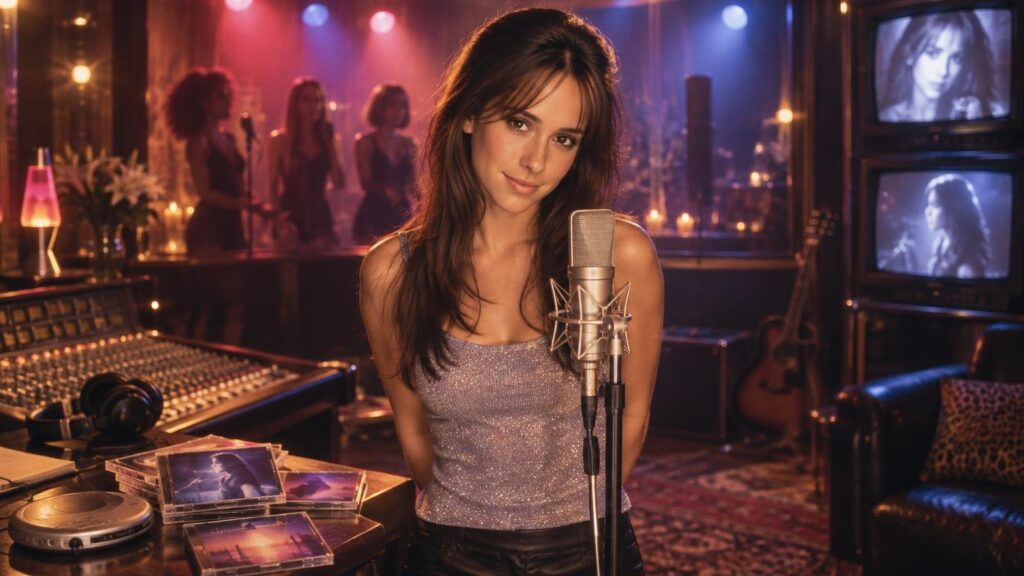
For 1990s television stars, releasing an album was not automatically treated as a novelty. Jennifer Love Hewitt, Joey Lawrence, Tatyana Ali, Raven-Symoné, Jasmine Guy and Alyssa Milano entered a music business willing to give actor-singers real albums, promotional campaigns and, in several cases, meaningful chart opportunities. The results ranged from short-lived curiosities to genuine hit singles, but the records belonged to the decade’s mainstream pop culture rather than sitting entirely outside it.
TLDR
The story of 90s actors and pop albums is bigger than celebrities briefly stepping into a recording booth. Joey Lawrence was promoted directly to the teen audience that knew him from Blossom. Tatyana Ali placed an album on the Billboard 200 and scored a major UK hit. Raven-Symoné recorded child-focused rap and R&B, while Alyssa Milano found a distinct market in Japan. Jennifer Love Hewitt’s 1995 album Let’s Go Bang places her squarely within this actor-singer moment, although the music itself ranged well beyond straightforward pop.
Jennifer Love Hewitt belonged naturally to the actor-singer era
Jennifer Love Hewitt is an especially useful anchor for understanding this crossover because music was not merely a late addition to her public image. Her wider career developed across television, film and recording, a progression explored in this Jennifer Love Hewitt career timeline. Apple Music lists Let’s Go Bang with a September 1995 release date, placing it in the same year that Hewitt joined Party of Five as Sarah Reeves.
That timing captures the unusual openness of the decade. A young performer did not always have to choose one fixed identity before an audience met her. Television could build recognition while music offered another stage for personality, image and vocal performance. For Hewitt, the album now feels like part of the same emerging-star story as her television work—not an inexplicable detour between acting credits.
It also helps explain why a simple list of “actors who made albums” can be misleading. Some performers had musical ambitions that predated or developed alongside their best-known screen roles. Hewitt’s recording work makes more sense when viewed as one strand of a broader performing career, as reflected in this contemporary-minded look at Jennifer Love Hewitt’s early music ambitions.
Joey Lawrence showed how television fame could launch a pop campaign
Joey Lawrence represents the most straightforward teen-pop version of the phenomenon. His self-titled album is categorized as pop by Apple Music, and the campaign openly drew on the audience that already knew him from Blossom. A February 1993 Radio & Records advertisement presented the record to that established teen audience and identified “Nothin’ My Love Can’t Fix” as its first single. Readers can see the original trade campaign in the Radio & Records archive.
The single reached No. 19 on the Billboard Hot 100. That result matters because it moves Lawrence’s recording career beyond the category of a vanity release remembered only by devoted sitcom fans. The television connection created attention, but a Top 20 single meant the music reached a broader commercial threshold.
Lawrence’s campaign also reveals the business logic behind these projects. A television star arrived with a recognizable face and an audience that understood his persona. The record still needed a usable song, radio promotion and a coherent sound, but the first step—getting teenagers to notice—had already been partly completed on television.
Tatyana Ali turned sitcom recognition into chart success
Tatyana Ali offers one of the strongest cases for taking the actor-to-singer transition seriously. After becoming familiar to viewers through The Fresh Prince of Bel-Air, she released Kiss the Sky through MJJ Music on October 23, 1998. Its 13 tracks included “Daydreamin’,” “If You Only Knew” and “Boy You Knock Me Out.”
Kiss the Sky reached No. 106 on the Billboard 200, giving Ali a documented album-chart presence rather than only a famous television credit attached to a record. “Boy You Knock Me Out,” featuring Will Smith, performed even more strongly in Britain: it peaked at No. 3 on the UK Official Singles Chart in February 1999 and spent 10 weeks on the chart across two runs. The complete chart history is available through the Official Charts entry for “Boy You Knock Me Out”.
Ali’s success also complicates the idea that these releases were manufactured distractions from acting. Her television fame certainly supplied visibility, and the Will Smith feature preserved a connection to the Fresh Prince world. Yet a No. 3 UK single is evidence that listeners engaged with the result as contemporary music. The screen association opened the door; it did not automatically produce that chart run.
“Pop album” covered several different sounds
The convenient phrase “90s actors with pop albums” conceals a wide musical range. Joey Lawrence fits the clearest pop-star template, but other crossover records moved through R&B, new jack swing and hip-hop. The distinction matters because these actors were not all chasing the same sound or audience.
Raven-Symoné’s debut album, Here’s to New Dreams, was released on June 22, 1993, with 10 tracks listed by Apple Music. AllMusic characterizes the project as child-oriented rap and R&B rather than conventional adult pop. AllMusic’s Raven-Symoné discography and biography provides useful context for that early recording work. Its single “That’s What Little Girls Are Made Of” reached No. 68 on the Billboard Hot 100.
That was a different proposition from selling Joey Lawrence as a teen heartthrob. Raven-Symoné was a child performer making age-specific music, and the album’s identity reflected that. It still belonged to the same broader entertainment system, however: a familiar television personality moving into recorded music with an organized release and a charting single.
Jasmine Guy’s self-titled album supplies another variation. Apple Music lists it as a 1990 Warner Bros. release. Guy brought the poise and cultural visibility associated with A Different World, but her musical context was closer to contemporary R&B and new jack swing than to the bright teen-pop shorthand now attached to many actor albums.
Alyssa Milano’s albums found a different audience in Japan
Not every crossover followed an American chart narrative. Alyssa Milano’s discography includes Locked Inside a Dream from 1991 and Do You See Me? from 1992, released in Japan through Pony Canyon, as well as the 1990 remix and compilation project The Best in the World: Non-Stop Special Remix/Alyssa’s Singles. Oricon’s catalog also documents Locked Inside a Dream.
Milano’s example is important because it shows how an actor’s musical career could be substantial in one market while remaining peripheral to how viewers elsewhere remembered her. American audiences might primarily associate her with Who’s the Boss?, yet Japanese listeners were offered a continuing sequence of releases rather than one isolated single.
That international path was not a lesser version of the actor-pop crossover. It was a targeted one. Celebrity recognition could travel differently from television market to television market, and record companies could build campaigns around the places where a performer’s image had particular value.
Why audiences were willing to listen
The decade’s entertainment culture made these transitions feel less unusual than they sometimes do in retrospect. Television delivered the same performers into homes every week, music videos made image central to pop, and teen magazines routinely treated acting, music, fashion and personality as parts of one celebrity package. A sitcom actor did not arrive at the record store as a complete stranger.
Recognition was only the opening advantage, however. The examples separate quickly once chart performance, musical positioning and target markets enter the picture. Lawrence had a Top 20 US single. Ali reached the Billboard 200 and the UK Top 3. Raven-Symoné’s project addressed a younger audience through rap and R&B. Milano’s albums developed a Japanese-market story. Hewitt’s Let’s Go Bang became part of a career that continued to move between screen performance and music.
Audiences therefore did not respond to one uniform category called “the actor album.” They encountered individual singles in radio formats and individual performers within particular fan cultures. Some listeners undoubtedly arrived because they recognized the face on the cover. Staying for the song was a separate decision.
These albums deserve more than a nostalgia punchline
It is easy to revisit actor albums with affectionate irony: the hairstyles, glossy covers and carefully coordinated promotional photographs practically invite it. But treating every release as camp misses what the charts and campaigns actually show. These were professionally positioned records competing within the pop and R&B markets of their moment.
The fairest way to revisit them is to ask what each performer was trying to do. Joey Lawrence pursued recognizable teen pop. Tatyana Ali built a credible late-1990s R&B campaign with measurable international success. Raven-Symoné made music shaped for a child audience. Jasmine Guy worked in a more mature R&B setting, while Alyssa Milano’s recording career followed an international route. Jennifer Love Hewitt belongs at the center of the conversation because her music was part of the same multi-hyphenate ambition that defined her early career.
The lasting takeaway is not that every actor who entered a studio became a major recording star. Most did not. It is that 1990s audiences and music companies were willing to consider the possibility sincerely. When the song connected—as it did for Lawrence and especially Ali—the actor label did not prevent listeners from treating it like a hit.
References
- Let's Go Bang – Album by Jennifer Love Hewitt – Apple Music
- Joey Lawrence – Album by Joey Lawrence – Apple Music
- Few artists start out with 23 million fans.
- Nothin' My Love Can't Fix
- Kiss the Sky – Album by Tatyana Ali – Apple Music
- Billboard 200 continued — OCTOBER 17, 1998
- BOY YOU KNOCK ME OUT – TATYANA ALI FT WILL SMITH | Official Charts
- Here's to New Dreams – Album by Raven-Symoné – Apple Music
- Raven-Symoné — Biography, Discography, Albums & Expert Reviews | AllMusic
- Here's to New Dreams – Image 3 from Through the Years: Raven Symone | BET
- Jasmine Guy – Album by Jasmine Guy – Apple Music
- Discography
- www.oricon.co.jp